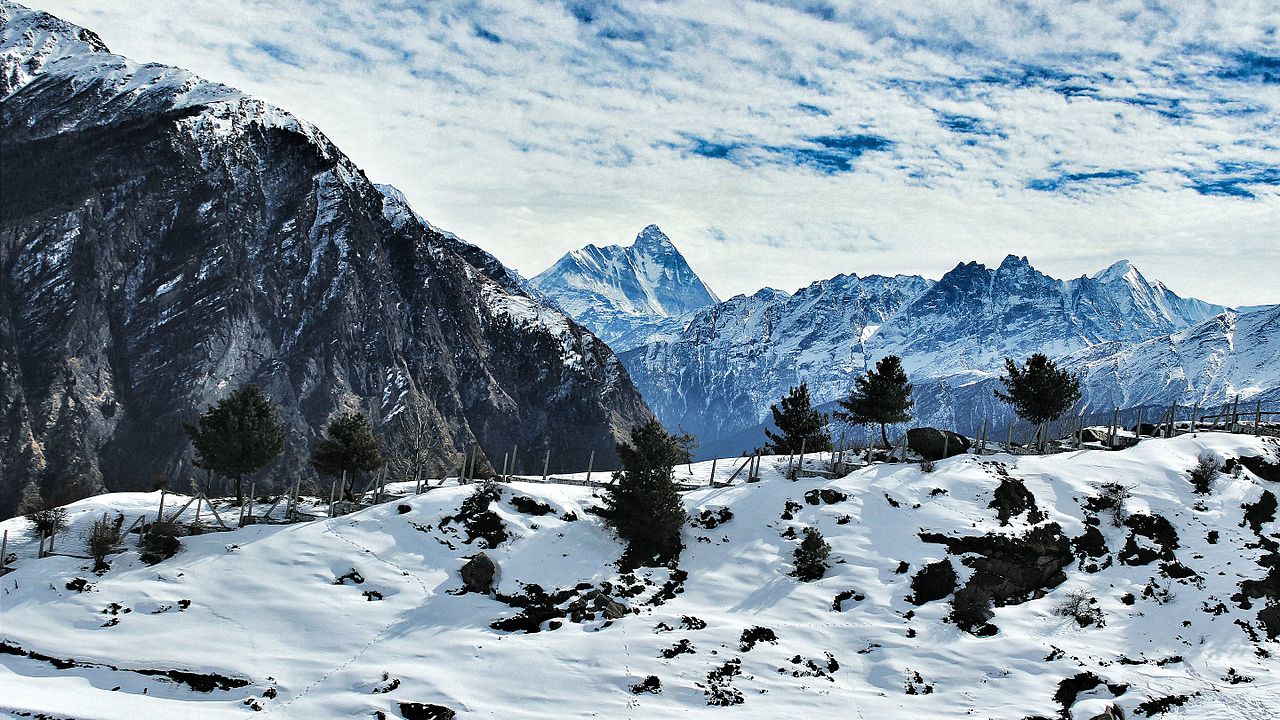
Uttarakhand — Dev Bhoomi: The Land of the Gods and the Sacred Himalayan Ranges
Uttarakhand — Dev Bhoomi, the "Abode of the Gods" — is where India's holiest rivers originate (the Ganges at Gangotri, the Yamuna at Yamunotri), where the Panch Kedar and Char Dham pilgrimage circuits draw millions of Hindus each year, and where the Garhwal and Kumaon Himalayan ranges offer some of the finest trekking, mountaineering, and wildlife viewing in Asia.
Overview
Separated from Uttar Pradesh in 2000 to become India's 27th state, Uttarakhand comprises two distinct cultural-geographic regions: the Garhwal Division in the northwest and the Kumaon Division in the southeast. Both are defined by the Himalayan ranges that rise from river valleys at 300 metres to peaks exceeding 7,800 metres (Nanda Devi, Kamet, Trishul). The state is almost entirely covered in mountains and forests — only the southern Terai strip along the Nepal border is flat — and nearly half its area is protected as national parks, wildlife sanctuaries, and forest reserves. This combination of ecological richness and spiritual significance has created a tourism economy that draws pilgrims, trekkers, wildlife lovers, and river-sport enthusiasts in roughly equal measure.
Top Places to Visit
- Kedarnath: The highest of the four Char Dham sites — the ancient stone temple of Lord Shiva at 3,583 metres, accessible only on foot or by helicopter and open only from May to November, survived the catastrophic 2013 flood when a massive rock diverted the floodwaters. The scene of pilgrims arriving after the 16-km trek from Gaurikund is deeply moving.
- Badrinath: Another Char Dham site — the Badrinath Temple at 3,133 metres on the bank of the Alaknanda river, with the Neelakantha peak (6,596 m) rising directly behind it. Mana village (3 km above Badrinath) is the last Indian village before the China border.
- Valley of Flowers National Park: A UNESCO World Heritage Site — a 87-sq-km glacial valley in Chamoli district that blooms with over 300 varieties of alpine wildflowers between July and September. Combined with the Hemkund Sahib pilgrimage (a Sikh shrine at 4,329 m), the trek is one of the great Himalayan walks.
- Jim Corbett National Park: India's oldest national park (1936) and the birthplace of Project Tiger — the Dhikala zone in the core area offers some of India's finest tiger and elephant sightings. The park is named for Jim Corbett, the hunter-turned-conservationist who shot the man-eating tigers of Kumaon and later worked to protect tigers.
- Rishikesh and Haridwar: The twin cities of the upper Ganges — Haridwar (the "Gateway of God") is where the Ganges enters the plains; its evening Ganga Aarti at Har ki Pauri ghat is India's most visually spectacular evening ritual. Rishikesh (the "Yoga Capital of the World") combines ashrams, river rafting, and bungee jumping in an improbable combination that somehow works.
- Auli: A ski resort in the Chamoli Himalaya at 2,519–3,049 metres — offering skiing from January to March with views of Nanda Devi (7,816 m) and connected by Asia's longest cable car from Joshimath.
Culture and Heritage
Uttarakhand's folk culture is expressed through Mangal (ceremonial wedding songs), Chholiya (sword dance performed at weddings in Kumaon), Jhora and Chanchari (community dances at harvest), and the Ramman festival of the Painkhanda Valley (UNESCO intangible heritage). The traditional architecture of the Garhwal and Kumaon regions — slate-roofed stone houses with ornate carved wooden windows — is a living vernacular tradition. The Kedarnath and Badrinath temples are active centres of the Shankaracharya monastic tradition established in the 8th century.
Cuisine
Uttarakhand's mountain food is warming and simple. Kafuli (spinach and fenugreek leaves slow-cooked in a yogurt base), Chainsoo (black gram curry), Bhatt ki Churkani (black soybean curry), and Sisunak Saag (nettle prepared with yogurt — only the tender tips used) are the distinctive dishes of the hills. Roti made from Mandua (finger millet) or Jhangora (barnyard millet) provides the carbohydrate base in traditional homes.
Best Time to Visit
April to June for pilgrimage and flowers; September to November for trekking and wildlife. The Char Dham yatra season opens in May (Akshaya Tritiya) and closes in November (Diwali). Jim Corbett is open year-round but best October to June.
How to Reach
Jolly Grant Airport (Dehradun) has daily flights from Delhi. The Himalayan Railway ("Shivalik Express") from Dehradun to Haridwar/Rishikesh is charming. National Highway 58 (Delhi–Badrinath) and NH 87 (Tanakpur–Pithoragarh) are the main road arteries into the mountains.
Travel Tips
- Register for the Char Dham yatra biometrically at the designated registration counters — mandatory and prevents overcrowding at high altitudes.
- Book Corbett Dhikala zone permits months in advance — only 12 jeeps enter per session.
- Carry woollen layers even in summer above 3,000 m — temperatures drop suddenly after 4 pm.
Have a better photo of Uttarakhand — Dev Bhoomi: The Land of the Gods and the Sacred Himalayan Ranges?
Upload your own photograph. If we approve it, you earn between 1 and 10 paise. Every photo is checked by our team before it appears.
Share this
Comments
Stay in Uttarakhand
We do not list a stay in Uttarakhand yet. Tell us your dates and we will find you one.
Plan it for meNext in the journal
Uttarakhand
Dehradun — The Doon Valley Gateway
Capitals · Between Ganga and Yamuna, Dehradun schooled India (Doon School, IMA) and perfumed it (basmati); it is the doo...
Uttarakhand
Nanda Devi — The Bliss-Giving Goddess
Wild India · India's highest wholly-Indian peak (7,816 m) rises inside a near-impenetrable ring of mountains; the Sanctu...
Uttarakhand
Rishikesh — Yoga Capital on the Ganga
Tourist Gems · Where the Ganga leaves the mountains, sages have meditated since antiquity; the Beatles' 1968 ashram stay...