



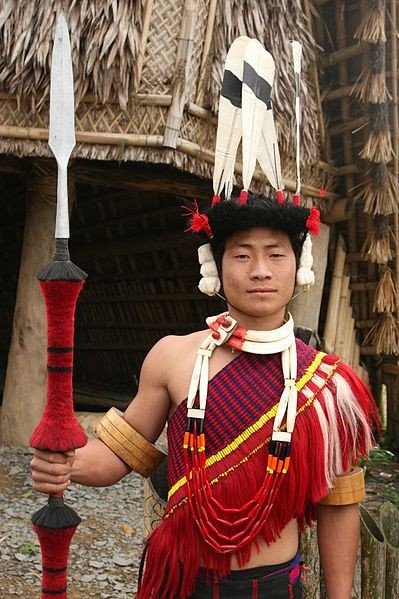
Image Credits : Retlaw Snellac Photography
The people belonging to the large number of indigenous communities residing in the North-Eastern part of India are together known as Nagas. It is quite common to find Nagas in India but specifically in the northern states of Nagaland, Assam, Manipur and Arunachal Pradesh. Majority of the Nagas are in Nagaland. There are many also found in the western parts of Burma or Myanmar.
Speaking of the tribes in Nagaland, there are a total of sixteen main tribes with their attire, signature hats and beaded jewellery. They all have their very own festivals celebrated throughout the year. All the tribes consider their festivals to be sacred and participating in the celebrations is mandatory for every individual. The Nagaland tribes celebrate their festivals with music, feasting and colours. The sixteen tribes of Nagaland are:
The Angami tribe is one of the most important tribal communities in Nagaland. The tribe is specifically found in the district of Kohima where they are divided into four distinct regions. These are Southern Angami, Northern Angami, Chakro Angami and Western Angami. These are hill people who mainly depend on livestock-rearing and wet rice cultivation. They are skilled at the terraced cultivation of wet rice and thus consider land to be highly precious. Traditionally, the tribe was a warrior group. Still, with the widespread knowledge of Christianity within the tribe, the people slowly moved to Christianity, and thus inter-village feuds and head-hunting activities suddenly came to a halt.
The Angamis are fond of music, and they favour the use of musical instruments like flute and drum. They play these instruments during their festivals and rituals. The main festival of the Angamis is Sekrenyi. Sekrenyi celebrations continue for 10 days in February. Men within the tribe wear shawls while the women wear wrap-around skirts and shawls in bold patterns and designs. The female attire here is known as Mechala. The Angamis, both men and women are known for the beautiful pieces of jewellery that they wear. These include pendants, bracelets, beads and bangles. Bamboo weaving, wood-crafting, cane furniture making and shawl weaving are some of the vital livelihood activities of the Angami tribe. The women within the tribe practise basket making and pottery. Pork made in combination with bamboo shoot forms the most typical dish of the Angamis.
This is yet another major tribe in Nagaland living in the Tsula (Dikhu) Valley region of the Mokokchung district. The people within this community celebrate several harvest festivals across the year. They are religious people with after-life beliefs. The tribe was a former community of head-hunters and highlanders but was highly influenced by Christianity bring in education and modernity into the tribe.
The Aos celebrate two main festivals held annually. These are Tsungremong and Moatsu. Tsungremong is the celebration of harvest held in the first week of August while Moatsu is celebrated in gratitude of Lijaba, the one who made the whole world. The Ao tribe appeals for the blessings of Lijaba for good crop harvest on May 2, the date of the festival.
There are three tribes found within the Chakhesang community and thus the name Chakhesang. Cha is for Chakri, Khe is for Khezha, and Sang is for Sangtam. Therefore, there are three languages spoken by the people within this tribe. These include Chakhru, Kheza and Sangtam. Former Eastern Angamis, the Chakhesangs are now a separate tribe in Nagaland. They reside in the villages of the Chozuba, Pfutsero and Phek sub-divisions of Nagaland.
At present, there are two crucial groups within this tribe, namely, Khezha and Chokri. There is yet another group called Zhavame or Zhamai belonging to the Poumai Naga tribe living in the Manipur region. The Chakhesangs celebrate their main festivals Sukrenyu and Thsukhenyie with great zeal and fervour. Sukrenyu is celebrated on January 15 while Thsukhenyie on May 6 in the Phek district of Nagaland.
As per legend, the Changs evolved from Changsangmongko and then started living at Changsang. The name Chang comes from Chognu or banyan tree that surprisingly emerged at the now-abandoned Changsang. Yet another legend has it that the Changs came from the eastern direction and named themselves Chang which means “east” in the local dialect. However, others within the tribe claim the Aos to be their ancestors. Like all the other tribes of Nagaland, the Changs practised head-hunting earlier, but over-time even this tribe has taken up Christianity. Lakbou, the chief of the Changs was earlier chosen by counting the number of heads hunted by a person. The one with the maximum number of heads was appointed Lakbou or the chief taking up the responsibility of managing administration within the village and settling village disputes.
The Changs celebrate Naknyu Lem as their main festival. As per mythology, earlier people within this tribe remained indoors continuously for six days because of complete darkness outdoors. The festival celebrates light on the 7th day and is filled with a lot of feasting and animal sacrifice as well. Men and women within the community clean the villages and homes; indulge in different sports, dance, sing and exchange gifts on this day. Bejewelled headgear and exclusive shawl-like clothes are the main dress of the changs. The people within this tribe eat different varieties of fish and meats with rice. They practice jhum cultivation as the main means of livelihood while also indulging in basketry, weaving, spinning and wood-carving.
The Kachari tribe in Nagaland is also called Dimas-Kachari with the history of the tribe ranging back to the days of the Dima-basa people. The tribe mainly has its origin in Assam, but people have slowly moved to Nagaland as well over the years. The tribe resides in the district of Dimapur in Nagaland. The Kacharis are known for their tribal attire that consists of several bright colours. The people within the tribe follow Christianity and Hinduism.
The Kacharis practice agriculture as their main occupation. They cultivate sesame, maize and cotton while cultivating oranges, pineapples, mustard and cotton in limited quantities. They practice difficult dance forms and also practice instrumental music. They do not sing songs but use the drum which they call Kharam. The people speak Grao-Dima and celebrate the festival called Buhsu Jiba or Bushu in the last week of January every year.
Khiamniungan people occupy the district of Tuensang in Nagaland along with some parts of Burma. This is a minor tribe believed to have migrated from the Upper Burma region along with the Yimchungers, another Nagaland tribe. The group arrived in Nagaland as one but divided into two communities at the village called Moru. The Khiamniungan, like all the other tribal groups of Nagaland, took up Christianity but this happened very late because of their isolated location.
The Khiamniungans wear clothes in bright blue and red colours and don their bodies with jewelleries made of conch shells and cowries. Bamboo flutes and drums made from gourds are the main musical instruments of the Khiamniungans. The people within this tribe took up jhum cultivation as their means of livelihood and celebrated Miu to commemorate the sowing season. Another festival celebrated by the Khiamniungans is Tsokum. This is a harvest festival in October filled with a lot of singing, dancing, eating, outdoor cooking, cleaning and road repairs.
One thing that is noteworthy about this Nagaland tribe is the tattoo on the body of the people. The Konyaks features exclusive tattoos all over their hands and face. They live in a district called Mon in Nagaland. In Arunachal Pradesh, they can be found living in the districts of Changlang and Tirap. In Arunachal Pradesh, the Konyaks are called Wancho Konyak. The tribe is believed to have followed the Morung system meaning “bachelor’s dormitories”. By way of this system, boys and girls, after attaining a certain age, were sent to dormitories where they remained till marriage or adulthood. Here, they were given lessons on warfare, traditions and culture along with varied disciplines. But the system has lost its importance with time.
Even the Konyaks indulged in head-hunting but were also fond of wars, attacking close-by villages of the other tribes and using their heads as trophies. Angship or hereditary kingship is the social system followed by the Konyaks. The Konyaks make sure that every village has an angh who takes up the responsibility of looking after the village administration. There are a total of seven angh leaders in the Mon district. The main festival of the Konyaks is Aoleang which is also known as Aoling Monyu. The festival is celebrated in April, and during this time the Konyaks dress up in traditional attire. They enjoy dancing, feasting and singing on the day.
The Kuki tribe in Nagaland is also called Chin in Myanmar and Mizo in Mizoram. The tribe is found in almost all the north-eastern states of India except Arunachal Pradesh. They have their very own exclusive traditions and customs. The boys within the tribe earlier studied at community centres called Sawn with the best students being recommended to the service of the Chief or the King. Lawm, a youth club, was a centre for learning for both girls and boys. The club also imparted practical and technical knowledge in regards to hunting, sporting, fishing and farming activities.
Men within the tribe wear brightly coloured jackets called Sangkhol and short dhotis known as Pheichawm. They also use wrap-around called chaddar. The headgear worn by the men is called Tuhpah. Women put on wrap-around called anih-san. Both men and women wear a lot of ornaments like bracelets, earrings, necklaces, bangles and ear lobes in the shape of a ring. The main festival of the Kukis is Mimkuut celebrated in January every year. The festival is celebrated with a lot of singing, feasting, dancing and drinking of rice beer.
The Lothas live in the Wokha district of Nagaland, and they were once part of the same community as the Rengmas. Just like all the other tribes of Nagaland, the Lotha tribe practised head-hunting in the earlier times and then gradually transformed into Christianity.
Their main festivals are Pikuchak, and TokhuEmong celebrated with great pomp and show. The festival of TokhuEmong is a harvest celebration falling in November. It is a 9-day long festival filled with dances, community songs and feast.TheLothas are known for their folk songs and colourful dances. The Lotha men wear shawls while the women wear Opvuram. The shawls of the men are called Longpensu.
The Phom tribe in Nagaland resides in the Yongnyah village. The territory of this tribe lies between the territories of the Aos, the Konyaks and the Changs. Not much is known about the origin of this Nagaland tribe. However, a legend has it that the Phoms evolved from stones. The tribe widely practises agriculture, and they are more into jhum cultivation. Spinning, pottery and bamboo work are also important means of livelihood of the Phoms.
People within the tribe wear ordinary clothes which include dark blue or white shawls or body wraps. The chief or the head wears a shawl jewelled with beautiful cowries and is called fanet-henyu, locally. Phom women wear shung-nang or skirts in different patterns and colours. The Phoms celebrate four festivals throughout the year, namely, Monyu, Bongvum, Paangmo and Moha. Their main festival is Monyu, celebrated for 12 days in April. The Phoms enjoy dancing, social work, singing and feasting during their festivals. Social work includes the construction of a bridge and infrastructural repairs.
Pochury is a Nagaland tribe living in the district of Phek, centred at the Meluri town. The town lies at a distance of 170 kilometres from the capital of Kohima. This composite tribe is formed through the amalgamation of three communities, namely, Khuri, Luchu and Kupo. Apart from the three communities, people from Rengma, Sangtam and Sema tribes have also joined the Pochury community.
Agriculture is the main form of livelihood for the Pochurys while they also practice animal husbandry. Fishing, hunting and forest produce are the major subsidiary occupations of the tribe. Terrace cultivation of wet rice and jhum cultivation was also practised by the Pochurys living near the Chichi and Tizu river basins. The annual festival of the tribe is called Yemshi which is again a blend of several festivals celebrated by the three sub-tribes that make the Pochury tribe. It is celebrated on October 5 every year. Nazu is yet another Pochury festival celebrated for 10 days in February.
There are two divisions within the Rengma tribe, and they are Western Rengma and Eastern Rengma. As has already been said, the Lothas and the Rengmas were once part of the same community, but later they separated into two distinct tribes of Nagaland. The Rengmas practised slavery which was later given up during the time of the British in India. The Rengmas are good at making yellow dyes from flowers, and they are also into practising cloth painting along with terrace cultivation.
The Rengmas wear clothes as per their social standing. Ethnic motifs, patterns, symbols and colours on the clothes vary accordingly. Rengma men who have never killed any enemy or never offered any feast wear Rhikho or a white cloth featuring four black bands. The count of the black bands differs as per age of the wearer. Young men within the community wear Moyettsu, dark blue clothing with broad bands and zigzag patterns in red. Important men wear Alungtsu. During the head-hunting ceremony, the men wear a shawl called Teri Phiketsu. Ngada is the main festival of the Rengmas. It is a harvest festival celebrated in November, marking the end of the cultivation season.
Sangtam is yet another important Nagaland tribe living in the southern regions of the state. They generally reside in the district of Kiphire and the northern regions of LongkhimChare in Tuensang district. The Sangtams widely practise jhum cultivation just like all the other Nagaland tribes. But, unlike the other tribes, the Sangtams have not given up their traditional cultures and beliefs.
They practice Christianity at present but do retain their original culture at the same time. Mongmong is the main festival celebrated by the Sangtams apart from eleven other celebrations that take place throughout the year.
You will find the Sumis in the district of Zunheboto in Nagaland. The Sumis are considered one of the most aggressive and united tribes of Nagaland. They are of an aggressive and ferocious nature, but despite this fact, the Sumis are also known for their honesty and simplicity. They are very loyal people and unparalleled friends.
Different festivals are celebrated by this tribe to celebrate the harvest of their new crops and also to mark victories at various wars. Ahuna and Tuluni are the main festivals of the group. Tuluni is celebrated in July, and it consists of a lot of feasting and merry-making. This mid-year celebration is also the time when the Sumis slaughter pigs and cows. Ahuna is celebrated on November 14. It is a post-harvest celebration when the entire Sumi community prepares its first meal made of rice from the harvest of the season. The meal is prepared in bamboo sections. Traditional dances and songs, along with different cultural and sports competitions, make the celebrations more exciting and fun-filled.
Residing in the Tuensang area of Nagaland, the Yimchunger tribe is said to have evolved in the Moru village. Just like the Khiamniungan tribe, Yimchunger is also believed to have come from the upper regions of Burma. The Yimchungers wear colourful headgear made of cane and all decked-up with bird feathers and animal hair.
The Yimchungers have received unique platforms and tools by the Nagaland government for sharing their craft, culture and traditions. A five-day-long celebration called Metemneo is the main festival of the Yimchungers. It is celebrated in August every year.
Zeliang or the Zemes tribe in Nagaland is also known as Zeliangrong. Zema Naga is the main dialect of this tribe which is now an endangered dialect. But the tribe still make use of this language. The villages of this tribe are found close to natural sources of water. They make their homes on top of hills and just like all the other tribes in Nagaland. Even the Zemes have given up head-hunting.
The Zemes celebrate Hega, which is one of the most important festivals of the tribe. It is celebrated in February every year. On this day, the Zemes tribal people invoke the blessings of God for prosperity and good health. This festival is filled with social gatherings and a lot of fun. Another popular festival celebrated by the Zeliangs is ChegaGadi. It is celebrated to thank God for a good harvest.
These are the sixteen most important tribes of Nagaland boasting of their customs and traditions. The plethora of festivals celebrated by the Nagaland tribes is what make Nagaland the state of festivals, as it is preferably and popularly called. Though the majority of the tribal people in Nagaland have resorted to living modern lives and practising the new era customs and traditions, there are still some tribes that require a lot of upheaval and renovation.